
Le retard à l'accélération du Jeep Gladiator est l'une des frustrations les plus fréquemment évoquées par les propriétaires, qu'ils soient conducteurs quotidiens ou passionnés de tout-terrain. Bien que le Gladiator soit conçu pour la durabilité et la polyvalence, sa réponse à l'accélérateur peut sembler retardée, incohérente, voire imprévisible dans certaines conditions. Ce guide complet explique tout ce que vous devez savoir : ce qu'est le retard à l'accélération du Jeep Gladiator, pourquoi il se produit et, surtout, comment améliorer la réponse de l'accélérateur et corriger ce retard.
Comprendre le retard à l'accélération du Jeep Gladiator et les plaintes des conducteurs
Le retard à l'accélération est le plus perceptible dans les situations de conduite à basse vitesse comme en ville, dans les embouteillages ou en progression lente tout-terrain. Les conducteurs le décrivent souvent comme :
-
Hésitation lors de l'accélération à partir d'un arrêt
-
Réponse moteur retardée après avoir appuyé sur la pédale
-
Sensation d'accélération incohérente
Pour certains, c'est une légère gêne. Pour d'autres, cela affecte la confiance, surtout dans les situations où une réponse immédiate de l'accélérateur est cruciale.
Comment le contrôle électronique de l'accélérateur influence le retard à l'accélération du Jeep Gladiator
Les véhicules modernes comme le Gladiator utilisent un contrôle électronique de l'accélérateur (ETC) plutôt qu'un système à câble traditionnel. Cela signifie :
-
La pédale d'accélérateur envoie un signal électronique
-
L'unité de contrôle moteur (ECU) interprète cette entrée
-
Le corps de papillon ajuste le flux d'air en conséquence
Ce système introduit un délai intentionnel pour améliorer l'efficacité énergétique, réduire les émissions et lisser l'accélération. Bien que bénéfique pour la réglementation et le confort, cette conception est la principale cause du retard à l'accélération dans le Jeep Gladiator.
Symptômes clés du retard à l'accélération du Jeep Gladiator en conduite quotidienne
Reconnaître les symptômes aide à distinguer un comportement normal d'un problème mécanique :
-
Accélération retardée au démarrage à l'arrêt
-
Hésitation suivie d'une puissance soudaine
-
Réponse lente en basse vitesse
-
Rétrogradages retardés sur les modèles automatiques
La cohérence est essentielle ; si le retard semble prévisible, il est probablement lié au logiciel.
Causes principales du retard à l'accélération du Jeep Gladiator
Le retard à l'accélération peut provenir à la fois de choix de conception et de conditions mécaniques.
-
Calibration de l'ECU d'usine : L'ECU d'origine est réglé de manière conservatrice. Il réduit la sensibilité de l'accélérateur à faible niveau d'entrée, créant une courbe d'accélération plus douce et progressive.
-
Accumulation de carbone dans le corps de papillon : Au fil du temps, des dépôts de carbone s'accumulent à l'intérieur du corps de papillon, restreignant le flux d'air et ralentissant la réponse. Cette condition peut accentuer la sensation de latence.
-
Défaillances du capteur de position de l'accélérateur : Un capteur défectueux peut envoyer des données incorrectes à l'ECU, entraînant une réponse retardée ou incohérente de l'accélérateur.
-
Restrictions d'admission d'air et erreurs du capteur MAF : Un flux d'air restreint ou des lectures inexactes du capteur de débit massique d'air peuvent perturber le rapport air-carburant, provoquant une hésitation.
-
Problèmes d'alimentation en carburant : Des injecteurs bouchés ou une pression de carburant faible peuvent retarder la réponse à la combustion, imitant un retard à l'accélérateur.
-
Réglage de la transmission automatique : La transmission du Gladiator est réglée pour l'efficacité, retardant souvent les rétrogradages. Cela peut donner l'impression d'une hésitation moteur même lorsque le système d'accélérateur fonctionne correctement.
-
Faiblesses du système d'allumage : Des bougies usées ou des bobines d'allumage défaillantes peuvent provoquer une combustion incomplète, entraînant une accélération lente.
-
Fuites de vide et déséquilibre air-carburant : L'air non mesuré entrant dans le système perturbe l'équilibre moteur, entraînant souvent hésitation ou à-coups.
Diagnostic du retard à l'accélérateur du Jeep Gladiator : approche étape par étape
Un diagnostic structuré évite des réparations inutiles :
-
Vérifier les codes d'erreur avec un scanner OBD-II
-
Inspecter le corps de papillon pour accumulation de carbone
-
Évaluer l'état du filtre à air et de l'admission
-
Tester la pression de carburant et la performance des injecteurs
-
Surveiller le comportement de la transmission
Ce processus aide à isoler si le problème est électronique, mécanique ou lié à la transmission.
Solutions éprouvées pour le retard à l'accélérateur du Jeep Gladiator
Traiter le retard à l'accélérateur du Jeep Gladiator nécessite une approche structurée, en commençant par l'entretien et en allant vers les améliorations de performance. Bien que le système électronique du véhicule présente un certain délai intégré, plusieurs solutions éprouvées peuvent améliorer significativement la réactivité.
Réparations d'entretien de routine
Avant d'investir dans des améliorations, éliminez les causes mécaniques courantes :
-
Nettoyage du corps de papillon restaure un flux d'air correct et réduit l'hésitation
-
Le remplacement du filtre à air et du capteur MAF garantit des calculs air-carburant précis
-
L'entretien du système d'alimentation améliore la réponse à la combustion
-
Les vérifications des bougies d'allumage et de l'allumage éliminent les ratés qui imitent un retard
Réinitialisation de l'ECU et réapprentissage adaptatif
Les Jeep Gladiator modernes reposent sur un apprentissage adaptatif. La réinitialisation de l'ECU peut :
-
Recalibrer la sensibilité de l'accélérateur
-
Éliminer les habitudes de conduite inefficaces
-
Améliorer la réponse à basse vitesse
Bien que ce ne soit pas une solution permanente, cela peut sensiblement améliorer la sensation à l'accélérateur, surtout après un entretien.
Optimisation du comportement de la transmission
Beaucoup de conducteurs confondent l'hésitation de la transmission avec un retard à l'accélérateur. Les solutions incluent :
-
Mises à jour logicielles chez les concessionnaires
-
Adaptation du style de conduite (appuis plus affirmés sur l'accélérateur)
-
Recalibrage pour un meilleur timing des passages de vitesse
Cet ajustement est particulièrement pertinent sur les modèles automatiques du Jeep Gladiator, où les rétrogradages retardés peuvent accentuer le délai.
Amélioration des performances : Contrôleurs de réponse de l'accélérateur
Pour les conducteurs recherchant une amélioration immédiate et perceptible, les contrôleurs de réponse de l'accélérateur sont parmi les solutions les plus efficaces. Un contrôleur de réponse de l'accélérateur améliore la réactivité de l'entrée d'accélérateur du véhicule en réduisant le délai entre l'appui sur la pédale d'accélérateur et la réponse du moteur. Cette pièce de rechange améliore la maniabilité et l'accélération du Jeep Gladiator, offrant une réponse d'accélérateur plus immédiate et linéaire, particulièrement utile en tout-terrain ou lors d'une conduite dynamique. Continuez à lire pour en savoir plus sur le meilleur contrôleur de réponse de l'accélérateur du marché : Pedal Commander® !
Contrôleur ultime de réponse de l'accélérateur : Pedal Commander® pour Jeep Gladiator
L'une des solutions les plus reconnues dans cette catégorie est le contrôleur ultime de réponse de l'accélérateur, Pedal Commander®, spécialement conçu pour éliminer le délai d'accélération dans le Jeep Gladiator. Il intercepte et modifie le signal entre la pédale d'accélérateur et l'ECU, permettant une réponse moteur plus rapide sans modifier la puissance du moteur. Avec plus de 15 000 avis positifs et certifications des organisations les plus réputées de l'industrie automobile, Pedal Commander® offre une accélération instantanée, que vous affrontiez des routes de montagne, tractiez votre bateau ou rouliez sur l'autoroute.
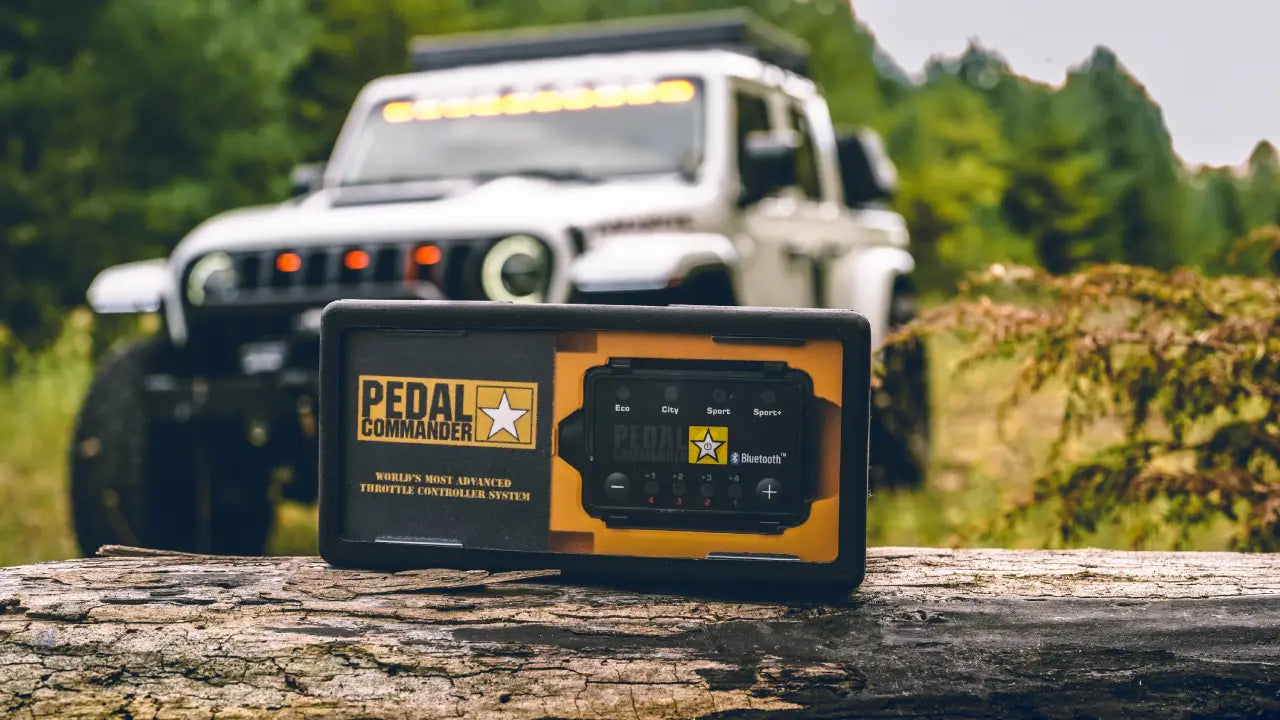
Ce qui distingue le Pedal Commander®, c'est le niveau de personnalisation que vous obtenez. Avec quatre modes de conduite, y compris Eco, City, Sport et Sport+, Pedal Commander® vous donne le contrôle dont vous avez besoin. Chaque mode dispose de neuf niveaux de réglage fin, pour que vous puissiez ajuster la performance selon n'importe quelle route à tout moment. Que vous tractiez, affrontiez un terrain accidenté ou ayez simplement besoin de plus de contrôle au volant, Pedal Commander® prépare votre véhicule pour toutes les aventures routières.
De plus, Pedal Commander® va au-delà de la performance grâce à sa fonction Anti-Vol. Lorsqu'elle est activée, cette fonction désactive la pédale d'accélérateur, empêchant toute utilisation non autorisée de votre véhicule. Profitez de la fonction Anti-Vol gratuitement pendant les 14 premiers jours, puis abonnez-vous facilement via l'application mobile Pedal Commander® et choisissez parmi deux plans d'abonnement : 0,99 $ par mois ou 9,99 $ par an, moins cher qu'un snack à la station-service !
Commandez le Pedal Commander® pour Jeep Gladiator ci-dessous !
###product###